InventorySolutionsFor AgenciesSmall & LocalWhite LabelExploreCompanyResources
Resources › Guides
Guide · Agencies

Dynamic Content Creation for DOOH

How agencies use dynamic, data-driven DOOH creative that changes by moment — without a production headache. Read it all here, or get the eBook by email.

By The Neuron TeamUpdated October 20265 chapters~15 min read
Chapter 01

From static screens to adaptive storytelling

A digital screen that shows the same ad all day is a poster with a power bill. Dynamic creative is where DOOH’s digital nature pays off: the message adapts to moment, place and audience — automatically.

Context drives attention. An iced drink at 3pm in the sun, an umbrella offer as rain starts, tonight’s fixture outside the stadium at 5pm — the same media placement, multiplied in relevance by timing. And relevance is a performance lever, not a gimmick: creative quality is the single biggest contributor to sales lift (Nielsen puts it at 47% — more than targeting, reach and context combined), and dynamic rules are how one strong creative stays right for every moment.
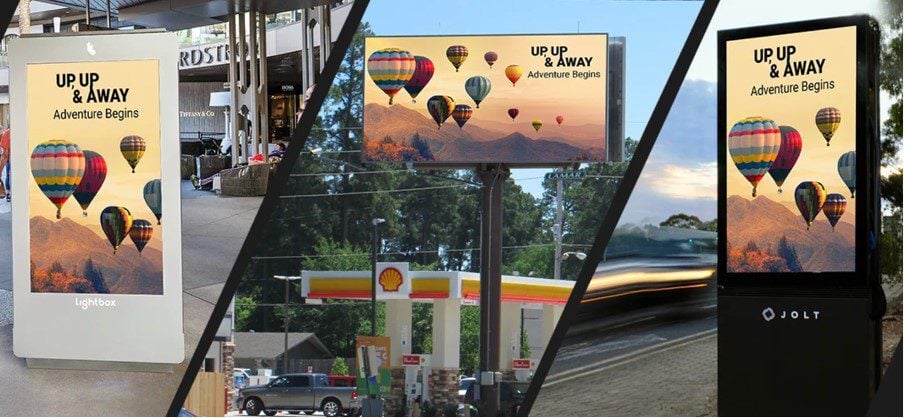
One campaign, adapted across placements and moments by context.

Chapter 02

The triggers worth using

  • Time & daypart — breakfast, commute, lunch, evening: the simplest trigger, and often the highest-value one.
  • Weather & temperature — the classic proof: Campbell’s ran signage only below a set temperature; Flonase triggered on high pollen counts. Hot coffee on rainy mornings, iced drinks in afternoon sun.
  • Location & proximity — distance to the nearest store, directions on the creative, screen-specific offers.
  • Live data — traffic conditions, flight arrivals, sports scores, news moments: creative that references what the audience is experiencing right now.
  • Audience movement — anonymized presence patterns deciding which message variant a screen shows at which hour.
Chapter 03

On-brand across every variation

Dynamic multiplies versions; the brand must survive every one of them.

  • Lock the master — logo zone, type scale, color system and layout grid are fixed; only the designated message and image zones vary.
  • Variant rules, not variant designs — define how the creative changes (copy slots, image swaps, color accents), so variations are generated, not redesigned.
  • DOOH readability rules still apply — seven words or fewer, bold sans-serif, high contrast, one image — on every variant, automatically enforced by the template.
  • Approve the system, not each output — client signs off the master and the rules once; variants inherit the approval.
Chapter 04

Feeds and rules: set it up so it runs itself

1

Choose the data source

Weather, time, location and live-data feeds are built into the platform — no engineering, no API project for standard triggers.

2

Write the rules

“If temperature > 28°C show variant A; otherwise B.” “After 6pm switch to evening offer.” Plain conditions, mapped to template variants.

3

Build variants from the master

Generate the variant set from your locked template — one master, every trigger state covered.

4

Launch and let it run

The platform evaluates conditions and serves the right variant per screen, per moment. No manual swaps, no babysitting.

5

Review the data

See which conditions and variants drive response, and refine the rules — dynamic campaigns improve in-flight.

Chapter 05

Where dynamic earns its keep — and where simpler wins

Dynamic earns its keep when…

  • The offer genuinely changes with context — food and drink, retail promotions, travel, events, weather-dependent categories.
  • The campaign runs long enough for rules to matter — multi-week flights across varied conditions.
  • Multiple locations face different moments — one master, locally right everywhere.

Simpler wins when…

  • The message is singular and brand-led — a launch, an announcement, an icon. One perfect creative beats five adequate variants.
  • The flight is short — setup cost should never exceed the window it optimizes.
  • The data feed doesn’t map to a real creative difference — if variants look the same, the trigger is theatre.

The discipline: dynamic is a performance tool, not a demo. Use it where context changes the message — and let a great static creative do its job everywhere else.

FAQ

Frequently asked questions

What is dynamic creative in DOOH?

Creative that changes automatically based on conditions — time of day, weather, location, live data — so each screen shows the most relevant version of your message.

Which triggers are worth using?

Time, weather, location and live feeds (scores, prices, countdowns) earn their keep most often. Pick triggers that change what you'd *say*, not just decoration.

Does dynamic creative cost more to run?

Setup takes more planning, but delivery costs the same — you're paying for the same screen time, just with smarter messaging on it.

When is a static ad the better choice?

When one clear message works everywhere, all the time. Dynamic earns its keep when context changes the message; otherwise simpler wins.

Prefer this guide as an eBook?

Enter your work email and we’ll send the designed 8-page edition straight to your inbox — keep it, or share it with your team.

One field — that’s it. You’ll receive the eBook by email.

×

Log in

Choose your platform to continue.
Agency & partner platformagency.theneuron.comSelf-serve (SMB)smb.theneuron.com