The playbook agency teams use to plan, pitch, run and prove programmatic DOOH — from first brief to proven results. Read it all here, or get the eBook by email.
Programmatic DOOH is now a channel you can pitch with confidence and prove with data. What separates teams that win budgets from teams that dabble is a repeatable operating system.
That system is four documents, and this guide is all of them: a brief checklist so every campaign starts complete, a creative-spec cheat sheet so production never blocks the buy, a proof framework so results survive the client review, and an objection script so the sale doesn’t stall in the room. Run the same four on every campaign and pDOOH stops being a special project — it becomes a service line.
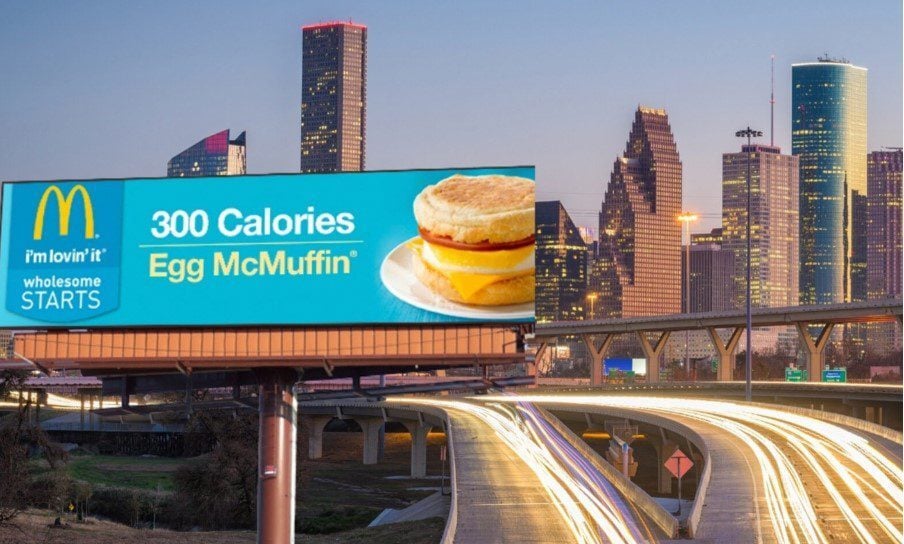
The channel is ready. The system is what makes it repeatable.
A complete brief is the difference between a campaign and a scramble. Before anything is booked:
Pin this next to every DOOH job:
Why the fuss: creative drives 47% of sales lift — more than targeting, reach and context combined (Nielsen). The spec sheet is a performance document, not a formality.
Three layers, reported in this order:
Plays, impressions, screens, dayparts — vs. plan. Thirty seconds of the meeting; establishes reliability.
Audience impressions, reach and frequency from movement data — the comparison layer against social and search.
The KPI from the brief: footfall uplift, redemptions, branded-search lift, brand-lift study. Framed in client math — cost per visit, cost per redemption.
Anchor expectations with the channel’s norms: DOOH reaches 80% of consumers weekly / 90% monthly, and about two-thirds of viewers take a measurable action after exposure (Nielsen/OAAA). Your campaign numbers land better inside a credible context.
The five objections you’ll hear — and the answers that keep the room moving:
Close with the moment, not the mechanism: show the client’s brand mocked onto a screen their customers pass daily — then ask which month they want to own it.
Objective, audience, geography, flight dates, budget, venue types, creative formats and the success metric — the checklist in chapter 2 covers all eight.
Resolution and orientation per screen, safe areas, duration, and legibility at distance — one message, high contrast, readable in three seconds.
Tie delivery data to an outcome: footfall uplift, brand lift or retargeting performance. Report outcomes first, media metrics second.
Reframe to cost per outcome: CPM-bought, fraud-free, 100% viewable impressions with no production or posting fees — then show the pilot numbers.
Enter your work email and we’ll send the designed 8-page edition straight to your inbox — keep it, or share it with your team.
One field — that’s it. You’ll receive the eBook by email.
