A step-by-step operating system for winning pitches and running digital out-of-home (DOOH) campaigns end to end. Read it all here, or get the eBook by email.
In today’s hugely competitive digital landscape, agencies are constantly seeking innovative strategies to stay ahead, captivate audiences, and maximize the impact of their clients’ campaigns. That’s no easy feat.
While online channels — particularly social media marketing and SEO — have long been the go-to media for digital agencies, consumer habits have changed, and marketing tactics need to change with them. Chief among the changes: a growing aversion to intrusive online ads, evident in the rising use of ad-blocking software worldwide.
of consumers use ad blockers across mobile and desktop — nearly 1 in 2 ads your clients pay for never see the light of day
of publisher ad revenue lost to ad blockers in 2020 alone
Even agencies that fight back with ad-block walls only irritate consumers further:
As an agency, delivering the best possible ROI for your clients is crucial — and increasingly, relying solely on traditional online channels isn’t delivering the goods.
Data sources: Vibetrace; Blockthrough / PageFair Adblock Report.
Thankfully, there’s a fantastic alternative you can add to your list of services immediately: a digital advertising medium that can’t be blocked, that consumers enjoy and remember, and that delivers high ROI — digital out-of-home advertising.
Growing at a CAGR of 11.6% over the forecast period
Data source: Contrive Datum Insights (CDI).
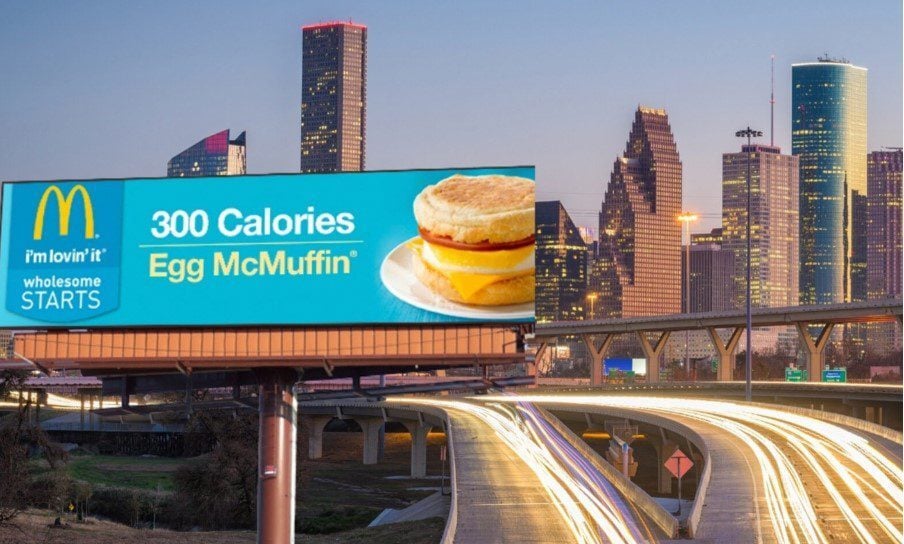
Roadside digital billboards reach audiences at scale — unblockable, unmissable.
In this guide, we take a deep dive into DOOH and reveal how marketing agencies can easily incorporate it into their service offerings to launch impactful, high-value campaigns for their clients — from immense reach and targeting capabilities to the hyper-contextual experiences it delivers, in the right place at the right time.
DOOH is a form of outdoor advertising that reaches target consumers in public spaces through the huge network of digital screens now found in every corner of major towns and cities.
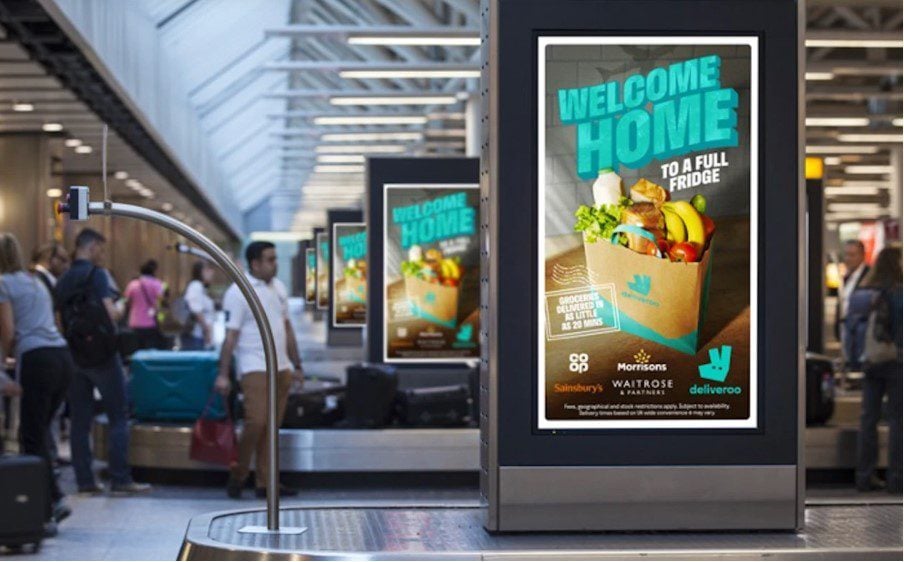
Place-based DOOH: digital screens reach travelers at airports and transit hubs.
Online shopping, while growing, still accounts for just 20% of total sales worldwide (Yahoo! Advertising) — the real action is in-person, exactly where DOOH comes into its own. Yahoo’s study of real-world exposure found:
of shoppers recalled noticing digital ad displays they were exposed to
said DOOH improved their shopping experience
purchased an item featured in a DOOH display — 65% of those purchases unplanned
The influence continues beyond the till: 84% of those who noticed a brand through DOOH would consider it again and talk about it with family or friends, and a majority engaged in follow-up activity — sharing on social media, or accessing a coupon or QR code.
Data source: Yahoo! Advertising consumer study.
Today, any marketing agency can easily add DOOH to its services thanks to programmatic DOOH (pDOOH) platforms.
Programmatic DOOH is the automated buying and selling of advertising space on digital displays in physical locations — combining the power of programmatic advertising technology with the reach and impact of out-of-home.
Through programmatic platforms, agencies can target specific audiences in just a few clicks, optimize campaigns in real time, and deliver dynamic, contextually relevant content on screens in malls, on street furniture and on roadside billboards. This data-driven approach gives advertisers greater flexibility, control and effectiveness by leveraging audience insights and real-time data.
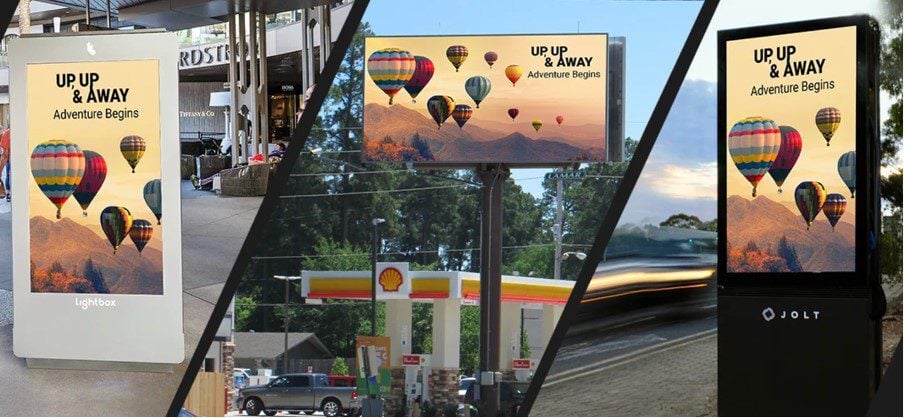
Contextual creative in action — the same campaign adapted across roadside and place-based screens.
pDOOH platforms tap into the wealth of anonymized mobile location data now readily available. With it, agencies can craft messages that resonate with specific audience segments — and target those segments in the real world based on real-time locational, demographic and behavioral information. Whether it’s commuters during rush hour or shoppers near retail hotspots, pDOOH delivers the right message to the right people at the right time.
Agencies that use pDOOH know its power to deliver results.
In JCDecaux’s study Programmatic Digital Out of Home: The Time Is Now, programmatic DOOH was found to be the best channel for delivering on both brand and performance KPIs — beating in-app marketing, social media, print, video, TV and radio.
Data source: JCDecaux — Programmatic Digital Out of Home: The Time Is Now.
As the digital marketing space becomes more saturated — and more complicated, with evolving privacy laws and cookie crackdowns — agencies need to broaden their offerings so clients can cut through the noise. From jaw-dropping billboards at Times Square and Piccadilly Circus to place-based screens in malls and bus stations, this flexible, unmissable, unblockable channel could be a game-changer for your business and your clients’.
The great thing: you can start offering programmatic DOOH in just three simple steps.
To offer programmatic DOOH, you need software: a demand-side platform, or DSP.
A DSP is an automated system that lets you bid for and purchase DOOH ad space remotely on behalf of your clients — with no unnecessary negotiations with middlemen or media owners. The platform does everything automatically, much like online programmatic advertising platforms do in the digital world.
DSPs connect with SSPs so DOOH buyers and sellers find each other — bids and purchases happen automatically, with no middlemen.
The best DSPs let you fine-tune precisely where and when your clients’ ads go live, under what conditions, and to which audience — families, working professionals, young people, or any other demographic — pinpointing where those audiences will be in relation to DOOH screens at specific moments of the day.
Powerful pDOOH DSPs also let you set criteria for when an ad shows — time of day, day of week, weather conditions — ensuring optimal exposure and maximum ROI for your clients.
Campaign success is driven primarily by the quality of the creative.
You have seconds to land your message — especially on billboards people pass at speed. Aim for a message digestible at a glance: about seven words or fewer.
Sans-serif fonts read far faster than serifs. Avoid italics and decorative faces that slow the eye.
Contrast is everything: dark background with light text or vice versa. Never white text on a light background.
One strong image per ad — clutter slows comprehension. Help the consumer digest the information quickly.

Street-level creative done right: one image, short message, bold contrast.
Purpose-built DOOH design software — usually loaded with templates — makes the process extremely efficient and essentially turns you into a DOOH design expert overnight.
Data source: Nielsen creative effectiveness research.
With a modern DSP and a DOOH design platform ready, you’re fully equipped to add DOOH to your services — it really is that simple. The Neuron provides everything you need to start immediately.
The Neuron is a pDOOH DSP designed specifically for agencies: a programmatic power tool for fast, precision planning and data-driven audience targeting, with easy management and performance tracking. With live data feeds — weather, traffic and flight data — real-time availability of DOOH media, and single-click processes, you can build hassle-free, contextually relevant, hyper-targeted campaigns for your clients in minutes.
With The Neuron, your agency’s new service offering is just a few clicks away.
Clients already ask for it: DOOH is the fastest-growing slice of out-of-home, and agencies that answer with a plan — inventory, pricing, measurement — win the budget line before competitors do.
No — modern self-serve DSPs are built for existing media teams; if your team runs paid social, it can run programmatic DOOH.
Look for premium inventory access, transparent real-time bidding, audience and trigger targeting, screen-level analytics, and a workflow your team can learn in a day.
Screen-level delivery reports plus outcome measures — footfall uplift, brand lift, retargeting response — presented as business outcomes rather than media metrics.
Enter your work email and we’ll send the designed 15-page edition straight to your inbox — keep it, or share it with your team.
One field — that’s it. You’ll receive the eBook by email.
